Does the Block Universe Mean the Future Already Exists?
Does the block universe mean the future already exists? In the philosophical view usually called eternalism, past, present, and future events are all equally part of spacetime. That sounds like a simple yes, but it immediately opens a harder question: if the future is already there, is it also predetermined?
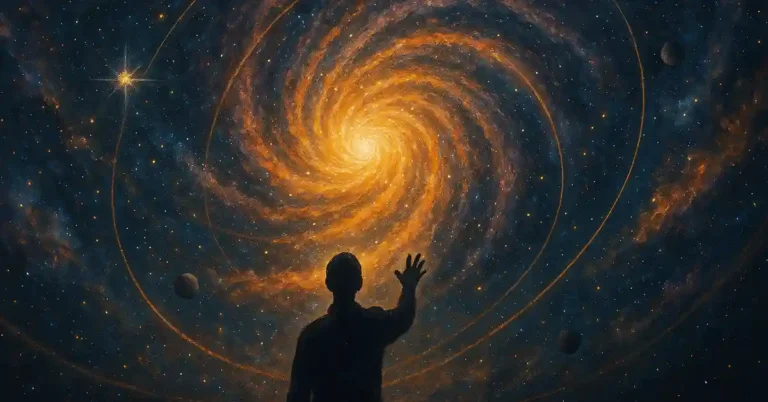
The distinction matters in science fiction. The Silent Guardian’s exploration of the nature of time imagines time as something closer to a four-dimensional structure than a river that literally flows. Modern philosophy of time gives us useful language for asking what that picture would actually mean.
What is the block universe?
The block universe is a common name for a view combining eternalism with a static or B-theory picture of time. Instead of treating the present as the only real moment, it treats events at different times as parts of one four-dimensional spacetime.
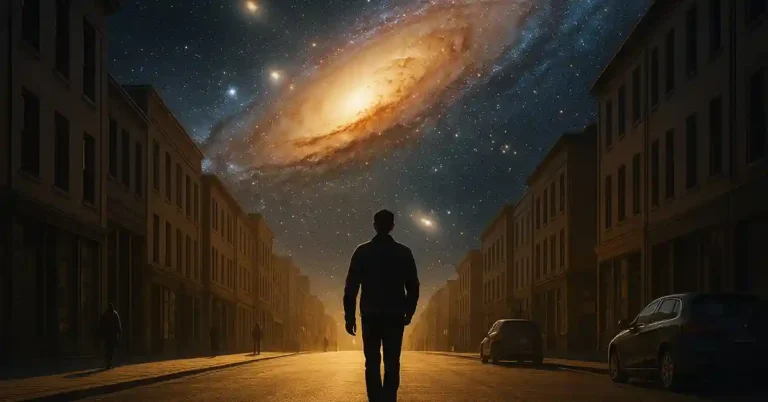
In that picture, your childhood is not “now,” and tomorrow is not “now,” but both can still be locations in the full spacetime structure. Stanford’s Encyclopedia of Philosophy entry on time surveys eternalism alongside competing views such as presentism and the growing block theory.
Does relativity prove the block universe?
Relativity is one reason the block universe is taken seriously, especially because different observers can disagree about which distant events are simultaneous. That weakens the idea of one universal cosmic “now.”
But moving from relativity to a complete metaphysical claim about what exists is still a philosophical step. Physics constrains our picture of time; it does not automatically settle every philosophical interpretation of that picture.
Does an existing future mean a determined future?
Not necessarily. Eternalism and determinism are different ideas. Eternalism is about which times are real. Determinism is about whether earlier physical conditions and laws uniquely fix what happens later.
A block universe could be described as containing a complete history without saying that every event was mechanically forced by the previous one. Whether genuine indeterminacy exists depends on deeper questions about physics and interpretation.
What happens to free will?
This is where the block universe becomes especially interesting for fiction. If a future choice exists somewhere in spacetime, is it still a choice?
One response is that your decisions are not excluded from the block; they are part of it. The later event happens in part because you decide and act. On that view, saying the event “exists” does not mean your decision is irrelevant.
Other theories of free will demand a stronger kind of openness, so the argument is not settled by vocabulary alone. The block universe creates the problem; it does not provide one universally accepted answer.
Why this matters for time travel
A block universe fits naturally with some fixed-timeline stories. If the past and future are already parts of one spacetime, a traveler going backward might be visiting an event that already includes their arrival.
That idea connects to the Novikov self-consistency principle, where a trip to the past cannot produce a contradiction. It also explains why fixed and branching timelines feel so different: one treats history as one globally consistent structure, while the other allows multiple histories or branches.
Does the block universe let you see the future?
No. Saying that future events are part of spacetime does not give an observer access to them. A map can contain a city you have not reached without giving you instant knowledge of everything happening there.
That limitation is useful for science fiction. A character might believe the future exists without being able to know it in advance. The story can preserve uncertainty for the character even if the underlying model of time is static.
The storytelling takeaway
The block universe is powerful because it separates two questions that fiction often combines: does the future exist, and can the future be changed? A story can answer those questions in different ways.
For The Silent Guardian, that tension sits at the center of Adam’s problem. Traveling through time may reveal that history is larger than the present moment, but it does not automatically reveal whether his choices are free, fixed, or already woven into the structure he is trying to change.
For a deeper philosophical overview, see the Stanford Encyclopedia discussion of temporal consciousness, then explore more Time Travel Theories & Sci-Fi Physics.