Novikov Self-Consistency Principle Explained for Sci-Fi Readers
The Novikov self-consistency principle is one of the cleanest answers to the classic question, “What happens if a time traveler tries to change the past?” Its answer is simple to state and wonderfully strange to think about: only events that are globally self-consistent can happen.
In other words, if you travel into the past, whatever you do there must fit the history that already produced your trip. The past is not a draft you can overwrite. Your visit was always part of it.
What is the Novikov self-consistency principle?
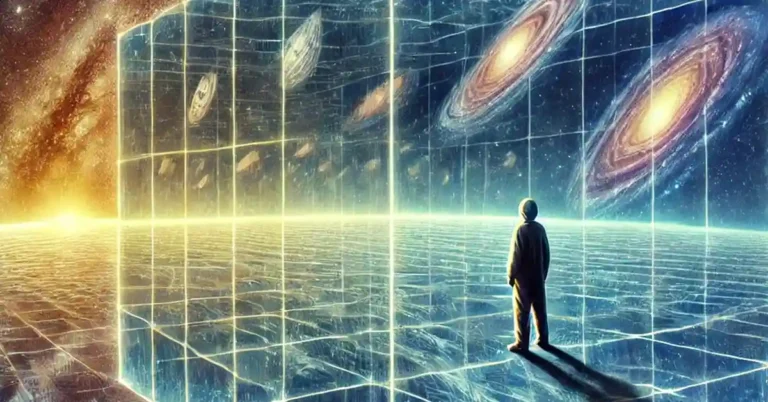
Physicist Igor Novikov developed the idea in discussions of spacetimes that contain closed timelike curves—paths through spacetime that, at least in certain solutions of general relativity, return to an earlier event. The principle says paradox-producing events have zero probability. History can contain time travel, but it cannot contain contradictions.
This does not prove that real time machines exist. It is a proposed consistency condition for what would happen if backward time travel were physically possible.
The billiard-ball thought experiment
A famous version imagines a billiard ball entering a wormhole and emerging in the past. The older ball then collides with its younger self. At first this seems capable of creating a contradiction: what if the collision prevents the younger ball from entering the wormhole?
Self-consistent solutions avoid that outcome. The collision can deflect the younger ball just enough that it still enters the wormhole on the trajectory required to create the collision. The event looks circular, but not contradictory.
What does this mean for a human time traveler?
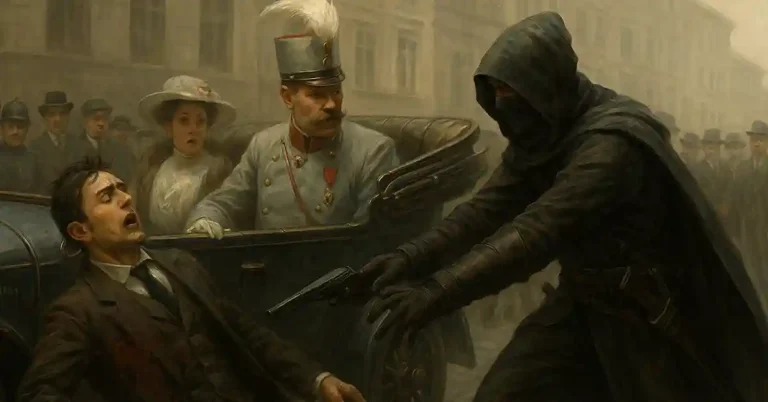
For fiction, the interesting consequence is that a traveler may have freedom to act, but not freedom to create an inconsistent history. Attempts to prevent an event can become part of the chain that causes it. A warning sent to the past may inspire the action it was meant to stop.
This is closely related to the structure behind the predestination paradox, where an attempt to change events turns out to be one of the reasons those events occurred.
Novikov vs. the grandfather paradox
The grandfather paradox asks what happens if a traveler prevents the circumstances required for their own existence or journey. Under Novikov-style consistency, the paradoxical outcome simply cannot happen. Something must prevent the contradiction—not necessarily through magic, but because only self-consistent histories are allowed.
That does not mean the universe has to “intervene” dramatically. The traveler could miss, change their mind, discover the target is not who they thought, or learn that their action was already part of family history.
Is the Novikov principle the same as fate?
Not exactly. “Fate” suggests a story-level force deciding outcomes. Novikov’s proposal is closer to a boundary condition: local events must fit a globally consistent spacetime. A character can still make choices, but some logically inconsistent combinations of choices are unavailable.
That tension between choice and consistency is one reason the idea works so well in science fiction.
How writers can use the Novikov principle
- Build dramatic irony: the audience sees how an attempt to change history completes it.
- Create mysteries: an object or message has no obvious origin until the time loop closes.
- Limit power: time travel becomes useful without making characters omnipotent editors of history.
- Make consequences personal: a character learns that the event they feared was partly caused by their own intervention.
Our guide to the bootstrap paradox explores one of the strangest consequences of self-contained causal loops: information or objects that seem to have no external origin.
Does physics say the principle is true?
No experimental evidence shows that macroscopic travel into the past is possible. The Novikov principle is important because it demonstrates that time travel and logical consistency are not automatically incompatible. Researchers have studied self-consistent solutions in theoretical models containing closed timelike curves.
For a deeper technical starting point, see the classic discussion of time travel and consistency in the Stanford Encyclopedia of Philosophy.
The storytelling takeaway
The Novikov self-consistency principle gives writers a disciplined rule: the past can be visited, but not contradicted. Once you accept that rule, time travel stops being a device for endless rewrites and becomes a machine for irony, revelation, and cause-and-effect puzzles.
If you want more examples of what those puzzles can look like, explore our time travel paradox examples.