Can a Time Traveler Meet Themself? What Physics and Fiction Say
Can a time traveler meet themself? In many fictional and philosophical models of time travel, yes. Simply encountering a younger or older version of yourself is not automatically a paradox. The real problem begins only if the meeting creates a contradiction with the history the story says already happened.
That distinction is useful in The Silent Guardian’s approach to time, where different moments can be treated as locations in a larger spacetime rather than as a single present that replaces the past.
Meeting yourself is not automatically a paradox
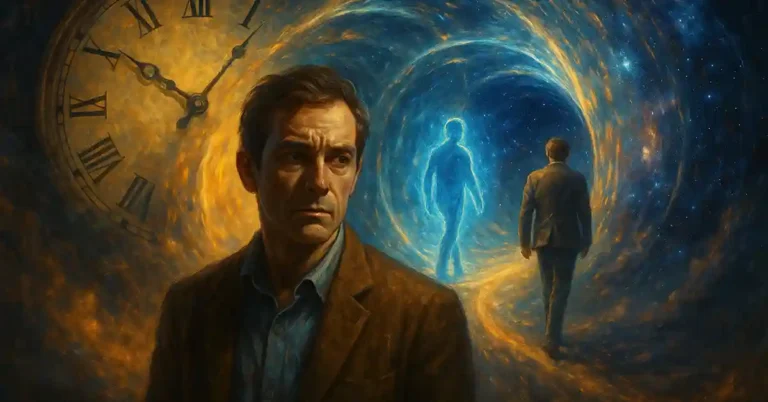
Imagine that at age forty you travel back and meet your twenty-year-old self. If the meeting was always part of your history, nothing contradictory has happened. Your younger self met a mysterious older visitor, and decades later you became that visitor.
The strange part is causal rather than logical: information can loop between different ages of the same person. That can create questions about where an idea or object originally came from, which is why self-encounters often overlap with causal loops and bootstrap paradoxes.
Fixed timeline: the meeting was always part of history
In a fixed-timeline story, there is one history. A traveler who goes into the past cannot create a version of events that contradicts the history from which they departed.
Under the Novikov self-consistency principle, events involving a time traveler must fit together consistently. If you remember meeting an older stranger when you were twenty, traveling back at forty may reveal that the stranger was you all along.
This model produces elegant loops because the traveler does not rewrite history. Their trip was already one of the causes that made history happen the way it did.
Branching timeline: which version did you meet?
A branching-timeline story changes the identity question. Traveling to the past may create or enter another branch, so the younger person you meet could be a counterpart whose future no longer has to match yours.
That avoids some contradictions, but it creates a different puzzle. If two versions now have different experiences, at what point should we call them different people rather than the same person at different ages?
Our guide to fixed vs. branching timelines explains how these two models change the rules of a story.
What would physics require?
Backward time travel itself remains speculative. General relativity contains mathematical spacetime geometries with closed timelike curves, which are paths that can return to an earlier event. That does not show that nature actually permits a person to build or use such a path.
The Stanford Encyclopedia of Philosophy’s overview of time travel explores why self-encounters can be logically coherent even when they feel counterintuitive. The philosophical question is often consistency, not whether two versions of one person can occupy the same room.
The deeper puzzle is identity
Meeting yourself forces a story to answer what makes a person the same person across time. Is identity continuous because of memory, the body, consciousness, or causal history?
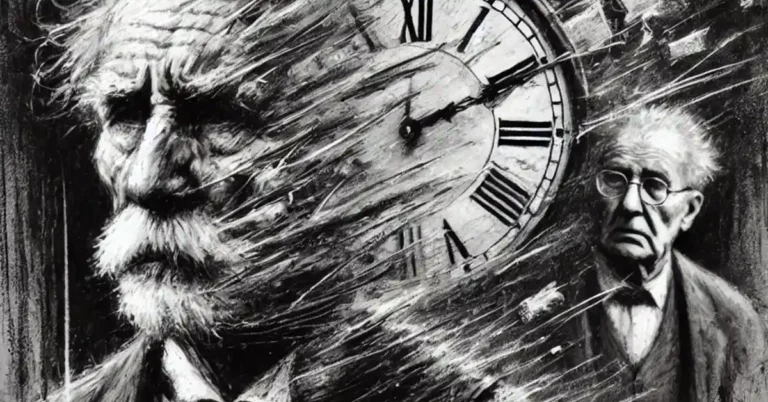
Normally we never confront two stages of one life at once. Time-travel fiction turns that ordinary fact into a visible problem. The older traveler remembers being the younger person, while the younger person has not yet lived the experiences that formed the traveler.
How fiction can make a self-meeting consistent
A convincing story needs clear rules. Decide whether history is fixed or branching, whether memories can change, and whether information can loop without an origin. Then keep those rules stable when the two versions interact.
Self-meetings become confusing when a story quietly switches models. A fixed timeline cannot suddenly allow a contradiction without explaining what changed. A branching model should make clear whether the traveler has returned to their own past or entered a related history.
The takeaway
So, can a time traveler meet themself? Conceptually, yes. A self-encounter does not automatically create a paradox. In a fixed timeline it may have always happened; in a branching timeline the meeting may involve two versions whose futures diverge.
The difficult questions are what happens next, whether causality stays consistent, and what “the same person” means once two ages of one life can stand face to face. Explore more in Time Travel Theories & Sci-Fi Physics, or follow those questions through The Silent Guardian online.