Can Information Travel Back in Time? Physics, Paradoxes, and Fiction
Could information travel back in time even if a human being could not? Science fiction often treats backward messages as an easier form of time travel: send a warning, a lottery number, or a scientific result into yesterday and avoid the engineering problem of moving a person.
From the standpoint of causality, however, a backward message is already enough to create most of the famous time-travel paradoxes.
Information is physical
A message needs a physical carrier or physical state: photons, electrical signals, printed marks, quantum systems, or some other medium. Sending information is not separate from physics simply because the payload is abstract.
If a signal arrives before it was sent in a way that can influence the sender, cause and effect can form a loop.
Relativity and faster-than-light signals
Special relativity makes faster-than-light communication problematic because different inertial observers can disagree about the temporal order of spacelike-separated events. In standard relativity, allowing controllable superluminal signals can be combined with changes of reference frame to construct apparent backward-in-time communication.
That is one reason faster-than-light signaling is not treated as a harmless shortcut.
Closed timelike curves can carry messages too
If a spacetime contained an accessible closed timelike curve, a physical signal could in principle follow the causal structure just as matter might. You do not need to send a whole person for paradoxes to appear.
The information bootstrap paradox
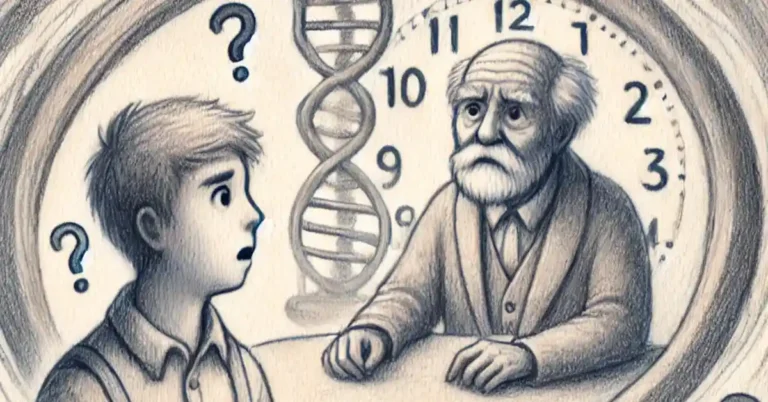
Imagine receiving a design from your future self, publishing it, and years later sending the same design into your past. Where did the design originate?
This is a classic bootstrap paradox. Every copy of the information has a cause, yet the information appears to have no independent creation event.
Can quantum entanglement send messages to the past?
No established experiment shows this. Entanglement produces correlations between measurement outcomes, but the no-signalling structure of quantum mechanics prevents ordinary controllable information from being transmitted faster than light simply by choosing a measurement on one side.
Claims that entanglement is already a practical faster-than-light communication channel confuse correlation with message transmission.
What about delayed-choice experiments?
Some quantum experiments have names and interpretations that sound retrocausal, but they do not allow an experimenter to send a readable message into yesterday and change a recorded result. Quantum foundations contains serious debates about interpretation; that is not the same as having a backward email system.
Self-consistent backward messages
In a fixed-timeline story, backward information can be allowed if it is self-consistent. The message you receive may be the reason you later send it. The Novikov principle offers one theoretical framework for thinking about such loops.
Why backward information is great for fiction
Messages are cheaper narratively than transporting people. A writer can explore causality through a radio burst, notebook, database record, dream-like signal, or machine output. The constraints can be tight:
- The message can contain only a few bits.
- It can travel only a fixed interval into the past.
- The sender cannot know whether it was received.
- Only one transmission is possible.
- History must remain self-consistent.
The scientific bottom line
No verified technology can make information travel back in time. Theoretical spacetimes and interpretations of physics motivate interesting questions, but controllable backward communication remains speculative. For fiction, that is not a weakness: a small, carefully defined information channel can create more elegant paradoxes than an unlimited time machine.