Wormholes and Time Travel: What Physics Actually Allows
Wormholes and time travel are closely linked in theoretical physics because a traversable wormhole could, under highly speculative conditions, connect not only distant places but different times. The idea grows out of general relativity, yet every step from mathematical solution to practical machine introduces enormous unresolved problems.
The important distinction is between what Einstein’s equations can describe and what nature can actually build.
What is a wormhole?
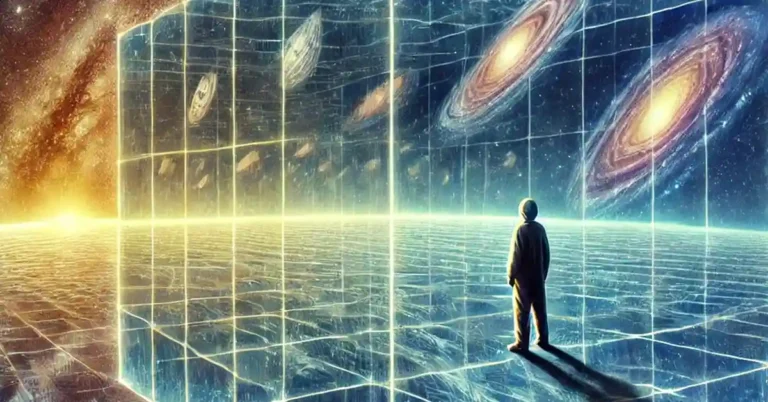
A wormhole is a hypothetical shortcut through spacetime connecting two separated regions. The original Einstein-Rosen bridge associated with black-hole geometry is not a convenient tunnel a traveler can cross. Later theoretical work explored whether a different type of wormhole might be kept open long enough to be traversable.
How could a traversable wormhole become a time machine?
Imagine two wormhole mouths, A and B. If one mouth undergoes high-speed travel or spends time in a different gravitational environment, relativity can make less time elapse for that mouth than for the other. The mouths could then become time-shifted relative to one another.
Travel through normal space from A to B might take you forward according to ordinary clocks, while passing through the wormhole could connect to the other mouth at an earlier external time. In the theoretical setup, that combination can create a closed timelike curve.
The exotic-matter problem
Traversable wormhole models generally require unusual stress-energy conditions, often described loosely as “exotic matter” with negative energy density relative to certain observers. Quantum field theory does permit limited negative-energy effects in specific situations, but nothing remotely like the stable, macroscopic resource needed for a human-sized wormhole has been demonstrated.
Stability is another challenge
Even if a tiny wormhole could exist, keeping it open while matter passes through is a separate problem. Radiation, quantum effects, and backreaction may destabilize the geometry.
This connects directly to the chronology protection conjecture: quantum effects might become destructive precisely when a wormhole configuration approaches a usable time machine.
Would a wormhole violate causality?
A time-shifted wormhole could create the same logical problems as other backward-time-travel models. A traveler might be able to influence events that help cause their own departure.
One response is the Novikov self-consistency principle, under which only events that fit one consistent history can occur.
Have scientists found a wormhole?
No confirmed observation has identified a traversable wormhole. Some astronomical objects can mimic aspects of black-hole signatures in theoretical models, but that is not evidence that usable shortcuts through spacetime exist.
Wormholes remain valuable because they test the boundaries of relativity, quantum field theory, and causality.
What science-fiction writers should decide
- Are wormholes natural, engineered, or both?
- Do they require rare energy conditions?
- Are both mouths created together?
- Can a wormhole connect to a time before it existed?
- Does history self-consist, branch, or resist paradoxes?
- Who controls stable wormholes and the infrastructure around them?
Those rules matter more to a story than pages of fake equations. Consistency gives the speculative technology weight.
The bottom line
Wormholes and time travel are physically interesting because general relativity contains mathematical structures that connect spacetime in surprising ways. But traversable wormholes require conditions that have never been shown to exist at useful scales, and turning one into a time machine adds even more problems.
That gap between mathematical possibility and engineering reality is exactly why wormholes remain such fertile territory for science fiction.