Sogdian Language: The Silk Road’s Forgotten Trade Tongue
What language helped Silk Road merchants communicate across Central Asia and into China? One major answer was Sogdian, an Eastern Iranian language carried by trading communities from the region around Samarkand. Around 313 CE, letters written in Sogdian recorded business deals, dangerous events, and even the worries of a woman stranded far from home. They offer a rare glimpse of the people behind the trade routes.
Sogdian became an important lingua franca across parts of Inner Asia, although merchants also used Chinese, Turkic, Persian, and many other languages depending on place and period. Discover who spoke Sogdian, how its alphabet worked, what the ancient letters reveal, and why its linguistic legacy survives in Tajikistan.
What is the Sogdian language?
Sogdian belongs to the Eastern Iranian branch of the Indo-European language family. That makes it historically related to other Iranian languages, but it is not an old form of Chinese, Arabic, or Turkic, and it is not simply another name for Persian. Linguists classify it as a Middle Iranian language.
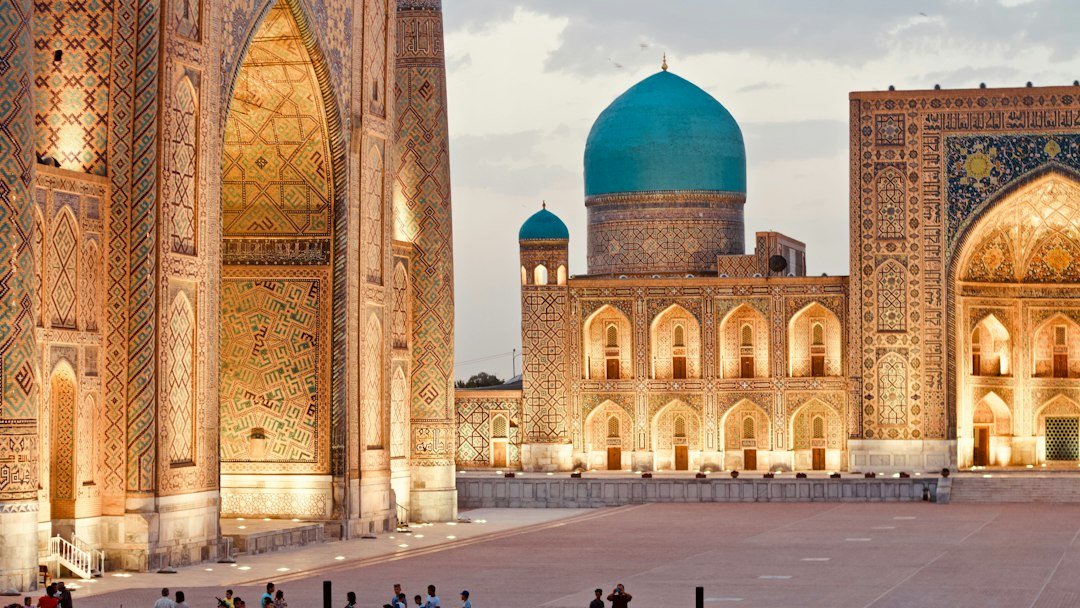
Its homeland was Sogdiana, centered on parts of what are now Uzbekistan and Tajikistan, particularly the Zeravshan valley and the trading cities of Samarkand and Bukhara. The language’s importance extended much farther than its homeland because merchants, translators, and religious communities carried it eastward across the trade routes.
Sogdian language at a glance
| Question | Answer |
|---|---|
| Language family | Indo-European → Indo-Iranian → Iranian → Eastern Iranian |
| Main homeland | Sogdiana, especially around Samarkand and Bukhara |
| Why it mattered | A widely used merchant and communication language along parts of the Silk Roads |
| When it flourished | Particularly in the first millennium CE; surviving texts extend into the early 11th century |
| Writing systems | Sogdian script, Manichaean script, and Syriac script |
| Still spoken? | Historical Sogdian is no longer spoken, but Yaghnobi preserves a descendant of a Sogdian dialect |
Why was Sogdian important on the Silk Road?
Silk Road trade was not one continuous road or a single market. It was a changing network of caravan routes, oasis cities, and political relationships. Sogdian traders became influential intermediaries, settling in trading communities across Central Asia and into China. Those communities helped merchants negotiate, maintain contacts, exchange news, and move goods over long distances.
For that reason, scholars describe Sogdian as a lingua franca in parts of Inner Asia: a shared language that people from different linguistic backgrounds could use for practical communication. That does not mean everyone from Chang’an to the Mediterranean could speak it. A merchant still might need an interpreter, use a local language, or communicate in several languages depending on the route and period.
The Sogdians also carried more than merchandise. Their communities helped spread texts and ideas associated with Buddhism, Christianity, Manichaeism, and Iranian religious traditions. Their role connects trade history with the history of writing and cultural exchange. For the broader geography, see our articles on Merv’s importance on the Silk Road and how long a Silk Road journey could take.
Where and when was Sogdian spoken?
Sogdian was spoken in Sogdiana itself and in communities established along the routes eastward. Its written record includes the Ancient Letters from approximately the early fourth century CE, texts found near Dunhuang and Turfan in present-day China, and early eighth-century administrative and legal documents from Mount Mug near the Sogdian homeland.
Scholars date much of the surviving written material to the seventh through early eleventh centuries, though evidence of the language is older. In Samarkand and Bukhara, Persian gained influence over time, and Turkic languages later became increasingly prominent. The transition was gradual and differed between cities and surrounding areas; languages did not simply switch on one fixed date.
That is an especially useful distinction for historical fiction. A character arriving in Samarkand in the sixth century might encounter a very different linguistic and political world from someone arriving there in the tenth.
What alphabet or script did Sogdian use?
The Sogdian alphabet was ultimately derived from Aramaic writing. Its familiar historical forms were adapted over centuries, and Sogdian could be written in different styles. It was not written with the modern Latin alphabet seen in English-language transliterations of Sogdian names. To see examples rather than just read about them, visit the Smithsonian’s illustrated guide to Sogdian scripts.
Scholars generally distinguish three principal writing systems used for Sogdian texts:
- Sogdian script: the most flexible system, used for secular and religious writings, including documents associated with commerce and administration.
- Manichaean script: used in Sogdian Manichaean religious texts.
- Syriac script: used in Sogdian Christian texts.
The Sogdian script was often written from right to left in its earlier forms; later writing practices also developed vertical layouts. Its cursive tradition influenced the Old Uighur script, whose descendants helped shape Mongolian and Manchu writing. This is one of the Sogdian language’s lasting contributions to the history of written communication. Encyclopaedia Iranica’s linguistic overview explains these developments in greater detail.
What do surviving Sogdian documents reveal?
The surviving record is more varied than a collection of merchant phrases. The Ancient Letters document Sogdian communities far from home; other finds include administrative and economic records, personal correspondence, inscriptions, and religious manuscripts. These sources tell us about families, religious affiliations, travel, and community life as well as trade.
The 1,700-year-old letters that make the language come alive
Imagine finding a bundle of mail near the western end of the Silk Road. Discovered near Dunhuang in 1907 and generally dated to around 313–314 CE, the Sogdian Ancient Letters were written by people living or working far from their Central Asian homeland. One merchant described upheaval in Chinese cities and discussed funds held back in Samarkand. Other letters tell of a woman abandoned in Dunhuang. They document business networks, but also ordinary fears and family ties.
This is why Sogdian matters beyond language textbooks: people used it to write home, report trouble, and manage relationships across enormous distances. The British Library’s International Dunhuang Programme introduction explains the letters, their discovery, and their historical context. You can also explore the Smithsonian’s illustrated Ancient Letters exhibit.
Manuscripts found in Dunhuang and Turfan preserve Buddhist, Manichaean, and Christian literature in Sogdian. The International Dunhuang Programme at the British Library describes two unusual works copied by a Sogdian scribe, including a document connected with the Zoroastrian faith and a story about the Iranian hero Rustam.
That diversity is important. Sogdian was a real language of a multilingual society—not a secret trade code or a dialect used only by caravan leaders.
Is the Sogdian language the same as Persian?
No. Sogdian and Persian belong to the Iranian language family, but they are different languages. Sogdian is classified as Eastern Middle Iranian, while Persian belongs to the Western Iranian branch and has its own historical development.
Some Sogdian words were borrowed into Persian through centuries of trade and cultural contact, but that does not mean Persian is simply Sogdian under a new name. A medieval merchant might know both languages, while a city could shift toward Persian over generations without everyone abandoning Sogdian immediately.
For additional linguistic context, see the Encyclopaedia Iranica article on Sogdian loanwords in Persian.
Is Sogdian still spoken today?
Historical Sogdian is no longer a living everyday language. But a closely related modern language, Yaghnobi, is still spoken in Tajikistan. Linguists identify Yaghnobi as the surviving descendant of a Sogdian dialect. It is not identical to the standard literary Sogdian preserved in manuscripts.
Yaghnobi provides linguists with valuable evidence for understanding older Iranian speech. Saying that Sogdian simply “vanished without a trace” would therefore miss an important part of its legacy. The Encyclopaedia Iranica entry on Yaghnobi explains the historical relationship and the modern speech community.
What other languages did Silk Road merchants speak?
The Silk Roads crossed enormous distances and operated over many centuries, so there was no universal language. Depending on where and when merchants traveled, they might encounter Chinese varieties, Sogdian, other Iranian languages, Turkic languages, Sanskrit and related literary traditions, Arabic, Persian, and many regional tongues.
In practice, multilingual traders, established merchant communities, interpreters, and local brokers made communication possible. A shared commercial language could help within a region without replacing the languages spoken at home, in government, or in religious life.
Why Sogdian matters in The Silent Guardian
Language is part of the challenge of moving through a world connected by trade but divided by culture and politics. In The Silent Guardian’s Samarkand installment, the city belongs to a broader fictional journey through the past. That historical backdrop raises good questions for time-travel storytelling: Can the traveler make themselves understood? Which century have they reached? Who controls the routes and the marketplaces?
The history of Sogdian offers a reminder that even the same place changes from era to era. Learn more about the setting, characters, and serialized chapters at The Silent Guardian novel hub.
Frequently asked questions about the Sogdian language
Who spoke Sogdian?
It was spoken by people in Sogdiana, especially in and around Samarkand and Bukhara, and by Sogdian communities established along trade routes across Central Asia and into China.
Was Sogdian the main Silk Road language?
It was one of the most important trade and communication languages in parts of Central Asia and Inner Asia, but no single language dominated every Silk Road route or century.
What script was Sogdian written in?
Sogdian was written in an Aramaic-derived Sogdian script, and some religious texts used Manichaean or Syriac writing systems.
What language is closest to Sogdian today?
Yaghnobi, spoken in Tajikistan, is the surviving descendant of a Sogdian dialect. It is related to—but not identical with—the historical literary language.
Sources and further reading
- Encyclopaedia Iranica: Sogdian Language I—Description, by Yutaka Yoshida, on linguistic history, scripts, and surviving manuscripts.
- Encyclopaedia Iranica: Sogdian Trade, on the merchant networks that spread Sogdian across the Silk Roads.
- International Dunhuang Programme: Two Precious Items Copied by a Sogdian Scribe, on surviving religious and literary texts.
- Encyclopaedia Iranica: Yaghnobi, on the surviving related language in Tajikistan.
In short: Sogdian was an Eastern Iranian language that became a major bridge between merchant communities along parts of the Silk Roads. Its scripts, texts, and surviving linguistic descendant show how much cultural history moved with the people who traded across Central Asia.