How Long Did It Take to Travel the Silk Road? A Realistic Ancient Journey
How long did it take to travel the Silk Road? There was no single answer because the Silk Road was not one road and most merchants never traveled from China to the Mediterranean in one uninterrupted trip. A full overland journey could take many months and, in some cases, far longer once weather, trade, politics, rest stops, and route changes were included.
That uncertainty matters for historical fiction. In The Silent Guardian’s desert journey, distance is not just scenery. Travel time shapes what a character can carry, where they can rest, and how much danger accumulates between cities.
The Silk Road was a network, not a highway
The Metropolitan Museum of Art describes the Silk Road as a collection of land and sea routes linking cities, trading posts, watering places, and hostels between China and the eastern Mediterranean. Goods usually moved from merchant to merchant rather than staying with one traveler for the entire distance.
That relay system is the key to understanding travel time. A bolt of silk might eventually cross thousands of kilometers, but the person who first sold it did not necessarily travel with it to the final buyer.
How far could a caravan travel in a day?
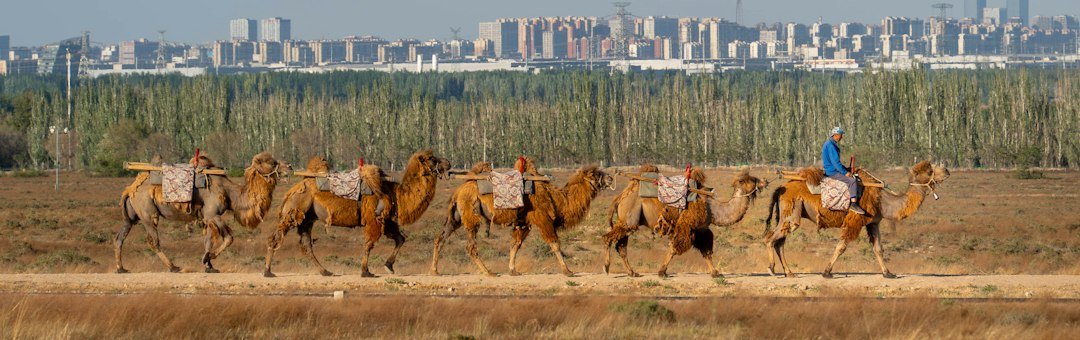
Daily distance varied enormously with terrain, weather, animals, cargo, water, and the condition of the road. Educational estimates often use roughly a few dozen kilometers per day for a caravan under decent conditions. That is useful for rough worldbuilding, but it should not be treated as a universal speed limit.
A route across flat, well-watered ground could move faster than one through mountains or deep desert. A caravan also lost time to loading, bargaining, repairs, illness, border controls, and waiting for safer travel conditions.
Why six months is only a rough estimate
If you divide a long east-west route by an optimistic daily caravan pace, you can produce a number around half a year. But that assumes constant movement with no meaningful delays. Real long-distance travel was messier.
Travelers often stopped for extended periods in major centers. Some changed caravans. Others waited for weather or joined larger groups before crossing difficult regions. A journey that looks like six months on a map could stretch far beyond that in practice.
Why merchants usually traveled only part of the route
Long-distance commerce worked because cities formed a chain. One merchant could carry goods to an oasis or market, sell them, and let another merchant move them onward. The Met notes that valuable goods were commonly traded from hand to hand and from town to town.
This made places such as Samarkand and Merv strategically important. They were not just dots on a route; they were exchange points where goods, languages, news, and travelers mixed. You can see those locations appear in The Silent Guardian’s Samarkand installment and the Merv meeting.
What slowed Silk Road travelers down?
The biggest delays came from geography and logistics. Mountain passes could close. Desert crossings depended on reliable water. Animals needed rest and forage. Travelers had to account for local authorities, tolls, market schedules, and changing political control.
Season mattered, too. The fastest route on paper was not always the safest route at a particular time of year. That is one reason the Silk Road developed multiple branches rather than a single permanent track.
A better answer for writers
For realistic fiction, avoid assigning one fixed speed to every journey. Instead, break the route into legs. Ask what terrain each leg crosses, where water and food come from, whether the traveler is alone or with a caravan, and how long they remain in each city.
A character moving urgently with light baggage can cover ground differently from a merchant caravan protecting valuable cargo. A time traveler who knows the future may understand the route, but still has to deal with the physical limits of the era.
The practical takeaway
So, how long did it take to travel the Silk Road? A complete overland trip could require many months and sometimes much longer, but most historical merchants traveled only sections of the network. The most accurate answer is not a single number; it is a chain of journeys connected by cities, markets, and handoffs.
For more historical context, explore The Met’s overview of Silk Road trade, then continue through The Silent Guardian online to see how distance and time become part of the story.