12 Science Fiction Technologies That Became Everyday Life
Science fiction technologies that became real are often presented as proof that writers predicted the future. The truth is more interesting. Fiction, engineering, and culture influence one another. Authors extend existing ideas, inventors grow up reading stories, and broad concepts can appear independently when society is ready for them.
These twelve examples are best understood as striking parallels, not claims that one novel directly caused one invention.
1. Video calling
Screen-based face-to-face communication appeared in speculative fiction long before smartphones made it routine. Today video calls are ordinary for work, school, medicine, and family life.
2. Tablet computers
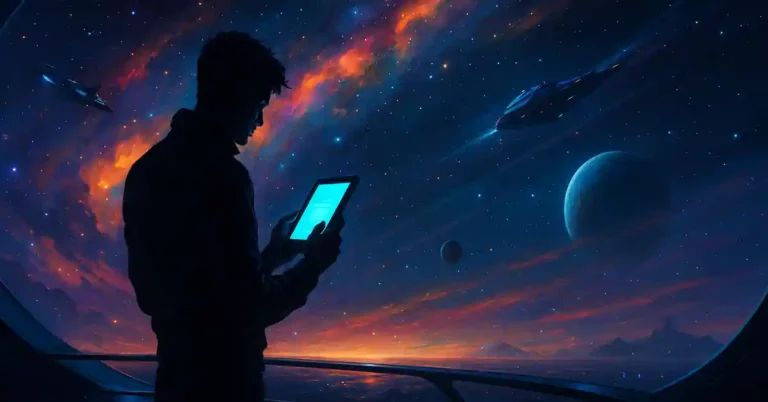
Portable flat-screen information devices became a science-fiction visual shorthand before modern tablets. Real tablets combine reading, writing, media, navigation, and communication in one thin device.
3. Voice-controlled computers
Talking to a computer once signaled a highly advanced fictional interface. Speech recognition and voice assistants now handle dictation, search, accessibility, home control, and routine commands.
4. Wireless earbuds and tiny communicators
Fiction repeatedly imagined miniature personal communication devices. Modern wireless earbuds are less dramatic than many fictional versions, but the social effect—private audio and communication almost anywhere—is familiar.
5. GPS-like navigation
Characters in futuristic stories rarely unfolded paper maps. Satellite navigation and smartphones now give ordinary users live positioning, route planning, traffic data, and location sharing.
6. Household robots
We do not have general-purpose robot servants in most homes, but specialized robots vacuum floors, mow lawns, clean pools, and automate repetitive tasks. The real path has been narrower and more task-specific than fiction often imagined.
7. Reusable rockets
Science fiction commonly treats spacecraft as vehicles rather than disposable launch stacks. Modern reusable launch systems have moved real rocketry closer to that operational idea, though spaceflight remains far from airline-like.
8. 3D printing
Fictional fabricators can produce almost anything. Real additive manufacturing is much more limited, but it can create prototypes, tools, medical devices, components, and structures directly from digital designs.
9. Biometric identification
Fingerprint and face recognition once looked like futuristic security. Biometric unlocking is now common on consumer devices, bringing both convenience and serious privacy debates.
10. Real-time translation tools
Universal translators remain fiction, but software can translate text, speech, signs, and conversations across many languages with increasing speed. Cultural context remains harder than converting words.
11. Smart homes
Connected lights, thermostats, cameras, speakers, appliances, and sensors resemble the responsive homes of older science fiction. The real versions also brought cybersecurity and privacy problems that stories sometimes skipped.
12. AI-generated text and images
Machines producing human-like language, images, music, and code were a speculative idea for decades. Modern generative systems made that capability widely accessible, while raising new questions about authorship, labor, accuracy, and creative practice.
Prediction is not the most important part
Science fiction’s real strength is exploring consequences. A story can be valuable even when the technology never appears. The interesting question is often not “Did the writer predict a gadget?” but “Did the story understand how a new capability might change people and institutions?”
That same principle guides our For Sci-Fi Lovers archive: ideas matter because of what they do to a world.
What fiction usually gets wrong
Real technology arrives unevenly. The futuristic device may exist while old infrastructure, paper forms, outdated laws, and human habits remain. The future is layered rather than clean.
That messiness is good news for writers. You do not need to predict the next device. You need to imagine believable consequences.