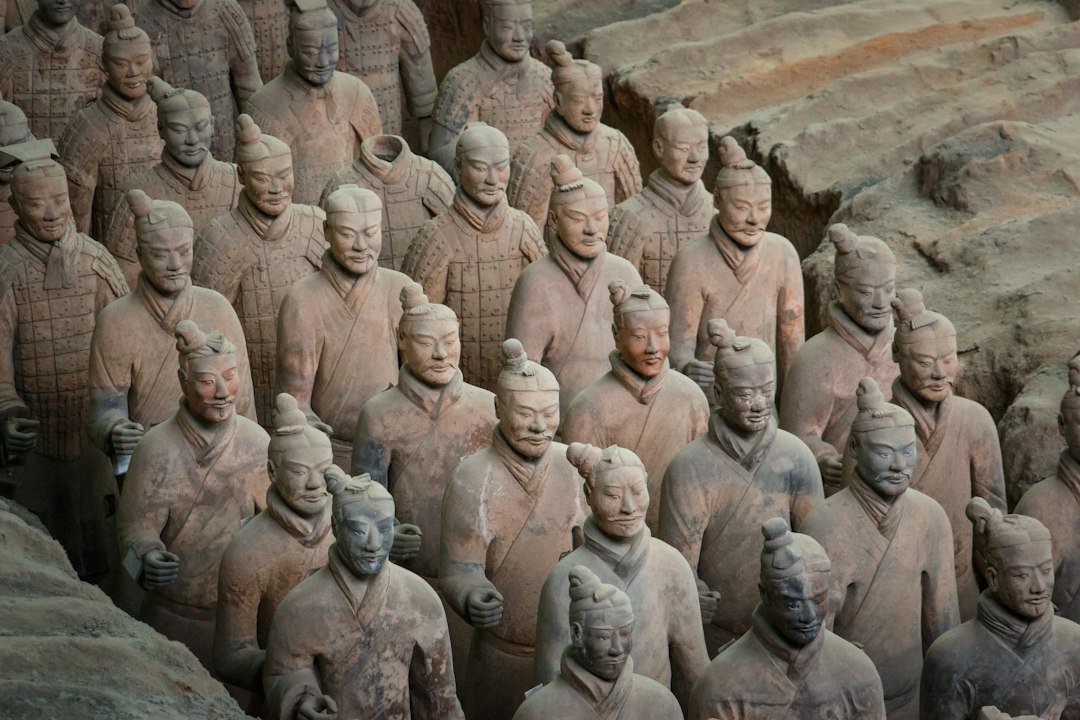
Why Did Qin Shi Huang Search for Immortality? The History Behind the Legend
Why did Qin Shi Huang search for immortality after becoming the first emperor of a unified China? The short answer is that enormous political power did not solve the one problem no ruler could command: mortality.
That tension is one reason Qin works so well in time-travel fiction. He unified rival states, standardized systems across his empire, ordered huge building projects, and then pursued a goal even larger than empire itself. In The Silent Guardian, that historical obsession becomes part of the backdrop for Adam’s mission in ancient China.
Who was Qin Shi Huang?
Qin Shi Huang was born Ying Zheng in 259 BCE. After becoming king of Qin, he defeated the remaining rival states and in 221 BCE declared himself the First Emperor. His reign transformed China politically and administratively, but it also created a ruler whose identity was tied to permanence. A dynasty meant to last for generations naturally raised a more personal question: could the emperor last, too?
That does not mean every later story about Qin should be accepted literally. Ancient accounts mix court history, political criticism, legend, and reports written after his death. Still, the evidence for his interest in extending life is unusually persistent.
What evidence shows Qin Shi Huang wanted eternal life?
Historical sources describe Qin sending people in search of substances or places associated with immortality. A 2017 report summarized by Smithsonian discussed ancient administrative texts showing that the emperor’s government circulated orders related to finding an elixir of life.
Other traditions describe expeditions toward legendary islands in the eastern sea, where immortals were believed to live. Whether every detail happened exactly as later writers described is less important than the pattern: Qin’s court treated longevity as a serious imperial concern, not a casual curiosity.
What did Qin’s court believe could extend life?
Qin’s search drew on a wider world of court specialists, medicine, cosmology, and traditions about extraordinary longevity. Historical accounts describe expeditions and advisers connected to the hope that rare remedies or distant sacred places might overcome ordinary human limits.
Modern historians treat many details cautiously because the surviving narratives were written through political and cultural lenses. The strongest conclusion is not that every legend is literal, but that the First Emperor devoted real attention and state resources to the possibility of extending life.
Why immortality made sense inside Qin’s worldview
For a ruler who had reorganized states, roads, measurements, currency, and political authority, death represented a limit that could not be standardized or conquered. The search for immortality also fit a wider world of court specialists, religious ideas, medicine, cosmology, and alchemical experimentation.
This makes Qin more interesting than the simple stereotype of a ruler who was merely afraid of dying. His quest can also be read as an extension of the same ambition that defined his political life: if order could be imposed on the empire, perhaps order could be imposed on time itself.
Why Qin Shi Huang is perfect for time-travel fiction
Time-travel stories thrive on characters who want to defeat time. Qin’s historical search for immortality creates an immediate thematic mirror for a fictional traveler. One wants to escape death by extending a single life; the other moves between eras and learns that surviving time is not the same as controlling it.
That question appears directly in The Silent Guardian’s discussion of the nature of time, where Adam considers whether the past and future already exist as part of a larger four-dimensional structure. It also connects to the site’s guide to fixed vs. branching timelines.
The historical takeaway
Qin Shi Huang searched for immortality because political victory did not erase mortality. Ancient evidence points to a sustained imperial interest in life-extending substances and legendary sources of eternal life, even though the exact details remain partly filtered through later texts.
That uncertainty is useful rather than frustrating. History gives us a real ruler with a documented desire to outlast death, while fiction gets to ask the larger question: what happens when someone finally gains power over time and discovers that time still refuses to obey?
Continue into the story: Browse Read The Silent Guardian Online to follow Adam’s journey across ancient China and beyond.