Grandfather Paradox vs Novikov Principle: Can the Past Change?
Grandfather paradox vs Novikov principle is really a comparison between a problem and one proposed way of avoiding it. The grandfather paradox asks what happens when a time traveler changes the past in a way that prevents the journey itself. The Novikov self-consistency principle answers that, if backward time travel is possible, contradictory events simply cannot occur.
That does not prove time travel works, and it does not mean the universe magically “protects” history. It means a self-consistent spacetime cannot contain an event that both happens and prevents itself from happening.
The grandfather paradox in one sentence
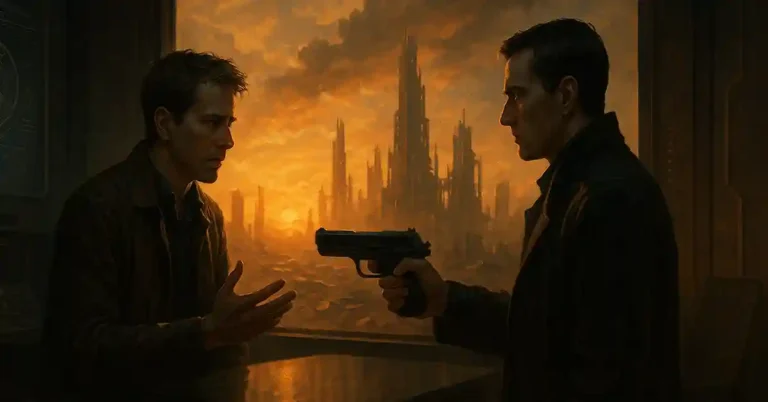
The classic grandfather paradox goes like this: you travel into the past and prevent your grandfather from having children. If you are never born, you never make the trip. But if you never make the trip, your grandfather survives and you are born after all.
The contradiction comes from combining two claims:
- You successfully change the past.
- The history that produced your trip still exists long enough for you to make that change.
A story can solve the problem by rewriting history, creating a branch, preventing backward travel, or requiring self-consistency.
What the Novikov principle says
The Novikov self-consistency principle is associated with physicist Igor Novikov and discussions of spacetimes containing closed timelike curves. Its core idea is that locally possible events must fit a globally consistent history.
Under this rule, you might travel into the past and attempt to create a contradiction, but the final sequence of events must still be compatible with the history that led to your journey.
You could miss. Your assumptions could be wrong. Your intervention could turn out to be the event that caused the history you wanted to erase. The point is not that some invisible force chooses the outcome. The point is that inconsistent histories are excluded from the set of possible histories.
Does Novikov destroy free will?
Not necessarily. The question depends on what a story means by freedom.
A character can still deliberate, choose, regret, and act. What the principle restricts is the combination of outcomes that would produce a logical contradiction. In a fixed timeline, the traveler’s choices are part of history rather than edits made from outside history.
This is why self-consistent time travel often feels like fate even when no supernatural fate exists.
What if the traveler really does kill the grandfather?
Then a single self-consistent timeline is no longer enough. One popular science-fiction answer is a branching model: the traveler enters or creates a different history while the original timeline remains intact.
That approach is explored in our guides to fixed vs. branching timelines and many-worlds and time travel.
In a branching story, the traveler can change the new branch without erasing the timeline that produced the traveler. The logical contradiction disappears, although new questions appear about identity, causation, and whether the traveler has actually “saved” their original world.
Grandfather paradox vs Novikov principle: the real difference
| Idea | What it describes |
|---|---|
| Grandfather paradox | A contradiction created when changing the past prevents the cause of the time-travel intervention. |
| Novikov principle | A proposed self-consistency condition under which paradox-producing histories cannot occur. |
| Branching timelines | An alternative model in which changes happen in another branch rather than overwriting the traveler’s origin. |
Why writers should choose the rule before the plot
Time-travel stories become confusing when the rules change whenever the plot needs a surprise. A writer does not have to use Novikov, but should decide what changing the past means before building the story around it.
- Can history be changed?
- If history changes, does the original timeline continue to exist?
- Can a traveler create a contradiction, or will events always remain self-consistent?
Those answers determine whether a grandfather-paradox scenario becomes impossible, self-fulfilling, or timeline-splitting.
What physics actually tells us
General relativity contains mathematical spacetimes with closed timelike curves, but that does not demonstrate that humans can build a time machine or travel into their own past. Other ideas, including Hawking’s chronology protection conjecture, suggest quantum effects could prevent macroscopic time machines from forming.
So the grandfather paradox remains a powerful test of a time-travel model, while the Novikov principle remains one logically coherent way to handle it.
The takeaway
The grandfather paradox asks, “What happens if I change the past so my trip never occurs?” The Novikov principle answers, “Then that contradictory outcome was never physically available.”
For more models, paradoxes, and story implications, explore our time travel theories and sci-fi physics hub.