The Silent Guardian — Chapter 9, Part 1: The Talisman
This installment continues The Silent Guardian Series. Previous: Chapter 8: The Desert Pursuit.
The desolation gives its travelers too much time to reflect. Every gust of wind whispers of the future. Every grain of sand carries memories. It pulls me back to General Tiberius Cassianus’ dimly lit chambers.
He had maps spread across his desk, their edges curled from use, each bearing the marks of military strategy. The man himself was not present yet, so I took the time to let my eyes wander. A general’s quarters always told a story. This one whispered of precision, control, and a man who valued the chessboard above the battlefield.
Then I saw it.
A small, ornate object hung above the narrow desk. Its bezel was etched with strange, intertwining patterns. In many ways, the symbols resembled the Mark of the Phylax: two spirals entwined in an eternal dance, their textured curves flowing endlessly into one another. They suggest harmony, transition, and the timeless rhythm of existence.
The talisman was unlike any I’d seen. It pulsed with a turquoise luminescence, a glowing heartbeat that felt alive. As I stepped closer, the light intensified. It was as though the object recognized me, responding to my presence with an unspoken acknowledgment.
Intrigue flared, a dangerous ember I had learned to extinguish. My fingers hovered over the talisman, but I stopped myself. The Phylax taught me that the mission was all that mattered. While on a mission, questions were luxuries we could not afford. However, the pull of the object was undeniable.
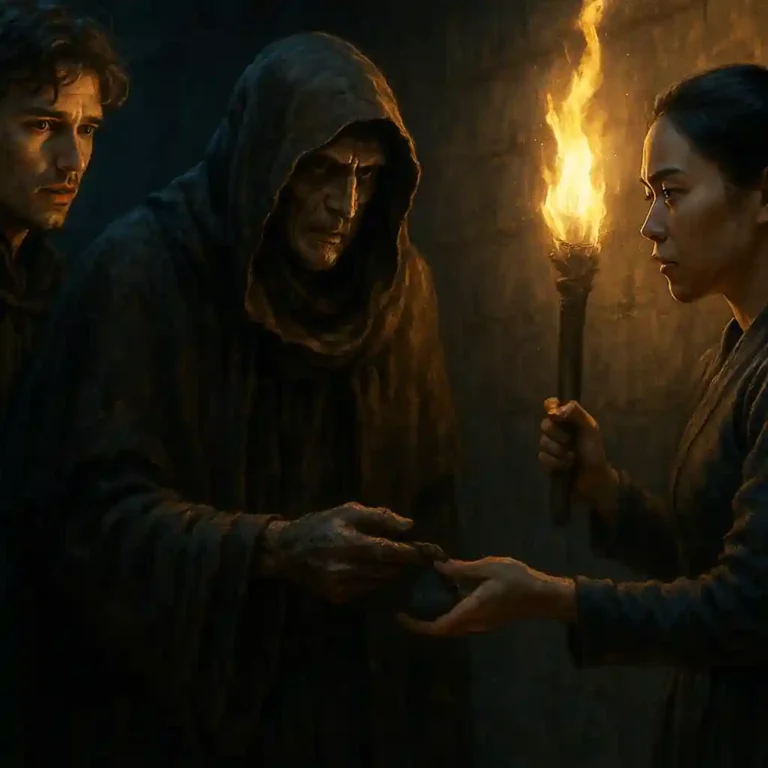
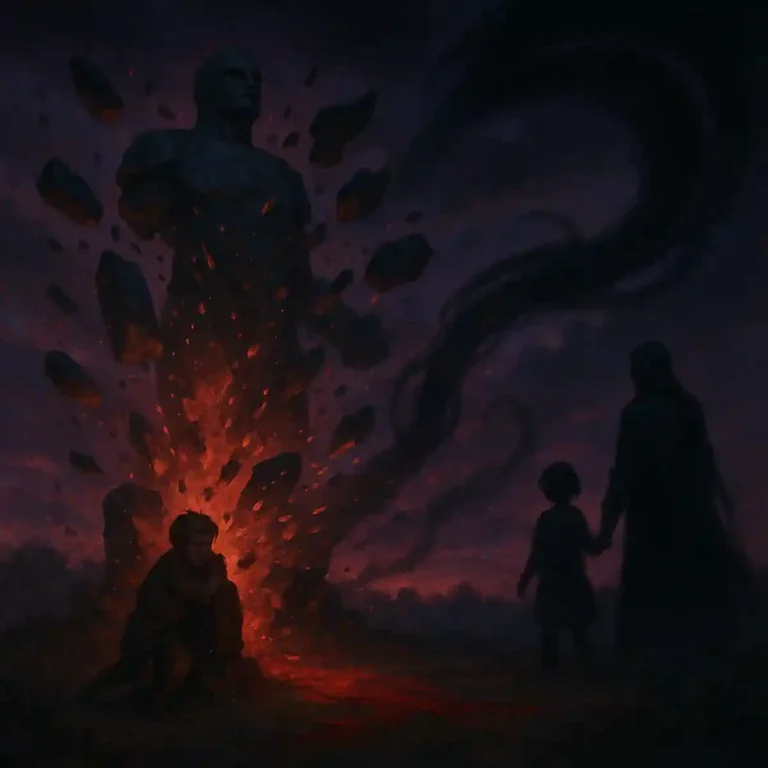
The sound of footsteps broke the spell. Tiberius Cassianus entered, his presence filling the room. He was a man built for command—stone-faced, broad-shouldered, and carved from stone. It wasn’t his stature that struck me. It was his demeanor: peaceful and resigned, as though he had seen the end of this encounter before it began.
He didn’t reach for a weapon. Instead, he walked to the desk, his attention shifting to the talisman before settling on me. “I know why you’re here,” he said, “I won’t fight you.”
I didn’t move. Cassianus’ composure was disarming, yet I held firm.
“You’re not the first,” he continued, leaning on the desk as though addressing an old acquaintance. “You won’t be the last. The Phylax never stop, do they?” He let out a small, bitter laugh. “They’ll send soldiers until the mission is complete. That’s their way.”
His words tightened something within me. I didn’t let it show.
“You don’t see it yet,” Tiberius said, his tone carrying pity. “You are on the wrong side of history.”
Of course, he would see it that way. He was somehow tied to the Sigma Event, though the Phylax never provided me with specifics. I only knew his actions would contribute to the death of billions. True evil always obscures itself in righteousness.
Tiberius straightened. “One day, you’ll see the truth. When you do, I hope it doesn’t destroy you.”
I could not endure his foolishness any longer. My blade cut through the air with all the force I could muster. He fell without a sound, his body a puppet with its strings severed.
I carefully lifted the talisman. The rhythmic pulse of its light drew my attention once again. Its hypnotic glow was infectious. Curiosity breeds hesitation, and hesitation is fatal for someone like me. I let its glow fade as I left the room. The talisman’s powers remained a mystery.
Why are these memories surfacing now? I’ve walked the desert countless times, always focused on the present. Yet, these unbidden fragments of the past are clawing their way back.
Many physicists argue that the past isn’t fixed. The act of observation can change what has already happened. They call it the Participatory Universe—the idea that the universe does not fully exist until something interacts with it, shaping its nature.
It sounds absurd, but a footprint in the sand does not exist until I step forward. The stars overhead do not shine in my vision until I look up. The universe is unfinished, uncertain, waiting for someone to give it form. What if time is the same way? What if my past is not a road I have already walked but something still taking shape beneath my feet?
I think of my recurring dream and its shifting details. Or the picture of the woman pulled from another time. Now, this—the memory of the talisman and the strange way it pulsated. I took nothing with me from that room. Yet, here in the silence of the desert, the memory refuses to let go of me. The more I think about it, the more it is an ember rekindled into a flame.
Maybe the past isn’t resurfacing. Perhaps it’s responding. If these physicists are correct, every moment I recall is an interaction with history. It is a thread being pulled from something unfinished. Maybe the talisman is more than something from my past.
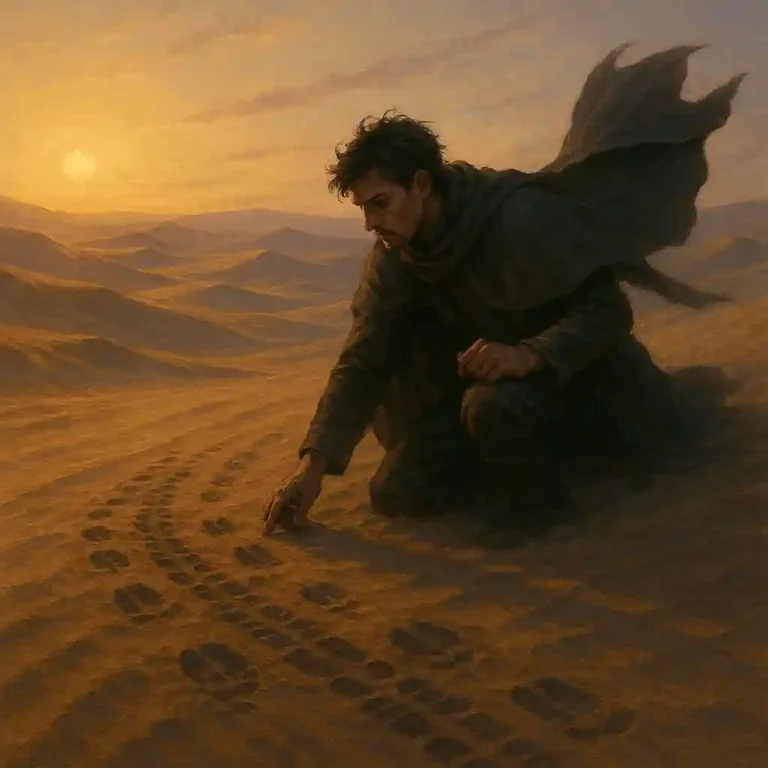
I return to the tracks, which become more distinct as I push on. They cut a path through the dunes. I still count three horses, and I am confident there are five men. My instincts thrum with the thrill of pursuit. I am closing in on my target. I climb the next dune. Sweat beads on my brow despite the early hour.
Cresting the ridge, I pause, squinting into the distance. Far ahead, a small cluster of figures moves steadily across the landscape. Even at this distance, I can see how controlled their formation is. Unlike the scattered patrols of Qin’s army. The sunlight catches flashes of dark metal that doesn’t match the worn brown leather that Qin’s soldiers wore. It’s impossible to make out the details, but my gut twists with recognition.
The way they sweep the terrain feels eerily similar to the soldiers who came for me in the village with Xia. I can’t see the golden trim or the Imperial Mark from here, but I don’t need to. I’ve seen enough to believe these are the ones who replaced Qin’s forces. The new power. Why they care about hunting down a ghost from a fallen regime is still unclear. One thing, however, is certain: they’ll be dangerous. I need to know more before I act. If they belong to the new Emperor, then I must be careful.
I stay low, fixed on the soldiers as they march across the desert. The contours of the land provide some cover. Each dune is a chance to slip out of sight. They remain disciplined but lack the urgency of someone being pursued. That means they don’t know I’m behind them. At least not yet.
Far in the distance, the outline of Sachu wavers in the heat and teases the edge of my vision. It has to be the town, though I know the sun-baked terrain is a master of illusions. The sight sends a spark of hope for resupplying. It also carries a warning. If those soldiers reach Sachu, they’ll have an advantage over me. I need to catch up with them before they cross into the town. Tonight is my window to strike.
The sun dips lower, cooling the air. Shadows stretch across the ground. I watch as they make camp, settling in for the evening. Soon after, their fire flickers in the twilight, allowing me to hone in on their position.
My muscles coil with anticipation. Nighttime is my ally, the cover I need to close in without detection. I watch their camp, the silhouettes of soldiers moving around the flames. My time will come soon enough.
I stay behind a dune, locked on the sentries, standing watch at the camp’s edge. They move lazily, not expecting an intruder in this void. It’s a mistake I intend to exploit.
Read The Silent Guardian on Amazon.
Explore the idea behind this installment: What Is the Participatory Universe Theory?
Continue with Chapter 9, Part 2. New installments publish daily at 5:00 AM.