How to Write Zero-Gravity Scenes That Feel Real
How do you write zero-gravity scenes in science fiction? Replace familiar Earth actions with consequences of free fall: a character must push against something to move, stop themself before drifting into equipment, secure loose objects, and rethink every gesture. The most convincing scenes aren’t packed with physics lectures. They give the reader a clear goal and then make microgravity complicate it.
In a spacecraft orbiting a planet, floating does not mean gravity has vanished. The ship and its crew are falling around the planet together. NASA’s explanation of microgravity describes that distinction. For fiction, the result is a new vocabulary of movement, effort, and accidental motion.
First, decide whether your characters are actually weightless
Not every spacecraft scene should have floating people. A ship accelerating steadily, a rotating habitat, or a fictional artificial-gravity device could make characters feel a force resembling gravity. A ship coasting through space in free fall generally offers a weightless environment. A planet’s orbital height alone does not explain why people float; their shared free fall does.
Write your setting rule before the scene: coasting in free fall, thrusting, rotating, or using speculative gravity technology. When the mode changes, the characters’ movement should change too. Our relativistic travel guide for science-fiction writers discusses how flight constraints can shape a story.
Five movement details that make a zero-g scene believable
1. Every useful movement begins with a push or pull
A crew member might hook a foot beneath a restraint, grip a handrail, or push off a bulkhead. A strong shove does not magically halt at the next room. Unless they grab a surface or collide with something, they keep drifting. NASA’s ISS demonstration of Newton’s laws is a useful writing reference.
2. Stopping is a skill, not an automatic action
A frightened character who launches toward a console might realize too late that their hands are occupied. Give them a choice: drop the equipment, reach for a strap, or strike the panel. This transforms an ordinary “run to the alarm” beat into a small physical dilemma.
3. Mass remains even when weight seems absent
A floating crate can be easy to support but difficult to accelerate or stop. The crate has inertia. Your character can guide it gently yet still be hurt if a heavy object drifts into them. Do not portray every floating object as effortless to throw or catch.
4. Hands and feet become tools
Characters often need to stabilize their bodies while working. A mechanic may anchor one toe beneath a rail, clamp a tablet into a holder, and use both hands on a valve. An argument can turn physical when someone deliberately releases a handhold and slowly drifts away.
5. The room’s orientation becomes negotiable
In sustained free fall, “up” and “down” can be conventions set by lights, labels, and the furniture. One character may arrive upside down relative to another. Avoid switching orientations mid-paragraph without a clear spatial anchor such as a hatch, colored wall, or fixed handrail.
Use sensory detail, but choose it carefully
Loose hair can spread rather than hang, water can gather into blobs, and tools need straps or holders. Inside a pressurized cabin, fans, voices, and machinery still make sounds: the often-quoted silence of space applies to vacuum, not an atmosphere-filled room. The air handling system matters because ordinary convection behaves differently in weightlessness.
The body changes too. Fluid shifts toward astronauts’ heads in microgravity, and some experience facial puffiness or congestion; see NASA on cardiovascular effects in microgravity. You needn’t mention every physiological effect. Choose the one that changes how the viewpoint character experiences this scene.
Before and after: revising an ordinary action scene
Flat draft: “Nera ran to the window, grabbed the data pad, and turned toward the captain. The pad slipped from her hands and fell to the floor.” This scene assumes gravity without establishing it.
Zero-g revision: “Nera kicked away from the doorway. The window came toward her faster than she expected. She caught the frame with one hand; the data pad spun from the other, its blue screen crossing the captain’s face before striking the vent grille. She could reach the pad or stay anchored for the captain’s answer. Not both.”
The revision doesn’t rely on exotic terminology. Each physical complication forces a decision and clarifies where the bodies are.
Three zero-g scene ideas to test your draft
- A secret conversation: Two people need privacy, but moving through the ship requires passing handrails near occupied workstations. The person overhearing isn’t at the door; they’re floating behind a partition above the speakers.
- A lost object: A vital sensor doesn’t fall beneath furniture. It drifts into a ventilation inlet. Retrieving it might obstruct airflow or require shutting down equipment.
- A rescue: An injured crew member can be moved without supporting their weight, yet their mass, momentum, and the narrow hatch still matter. Every rescuer needs a handhold.
Zero-gravity writing checklist
- What is causing the weightlessness: orbit/free fall, coasting, or a fictional mechanism?
- What does the protagonist push against to start moving, and how do they stop?
- Which hand is available to grab a rail during the critical action?
- Are loose tools, food, liquids, and clothing secured?
- Do heavy objects retain believable inertia?
- Can the reader picture the hatch, wall, restraint, and nearest obstacle?
- Does the unusual physics change a choice, relationship, or outcome?
Frequently asked questions
Is zero gravity in a space station scientifically accurate?
“Microgravity” or apparent weightlessness is more precise: an orbiting station remains under substantial planetary gravity, but crew and station fall together.
Can characters cry in zero gravity?
They can produce tears. What changes is how fluid moves and accumulates instead of simply running down a cheek. The emotional meaning of crying can remain perfectly familiar.
Would a zero-g punch send both people flying?
Both bodies experience forces. The result depends on their masses, their grips or restraints, and the direction of the contact. A character anchored to a handhold behaves differently from an unrestrained one.
For more setting-level consequences, explore space-colony story ideas and generation-ship worldbuilding questions. The key is to make movement part of storytelling—not a paragraph of physics pasted between actions.
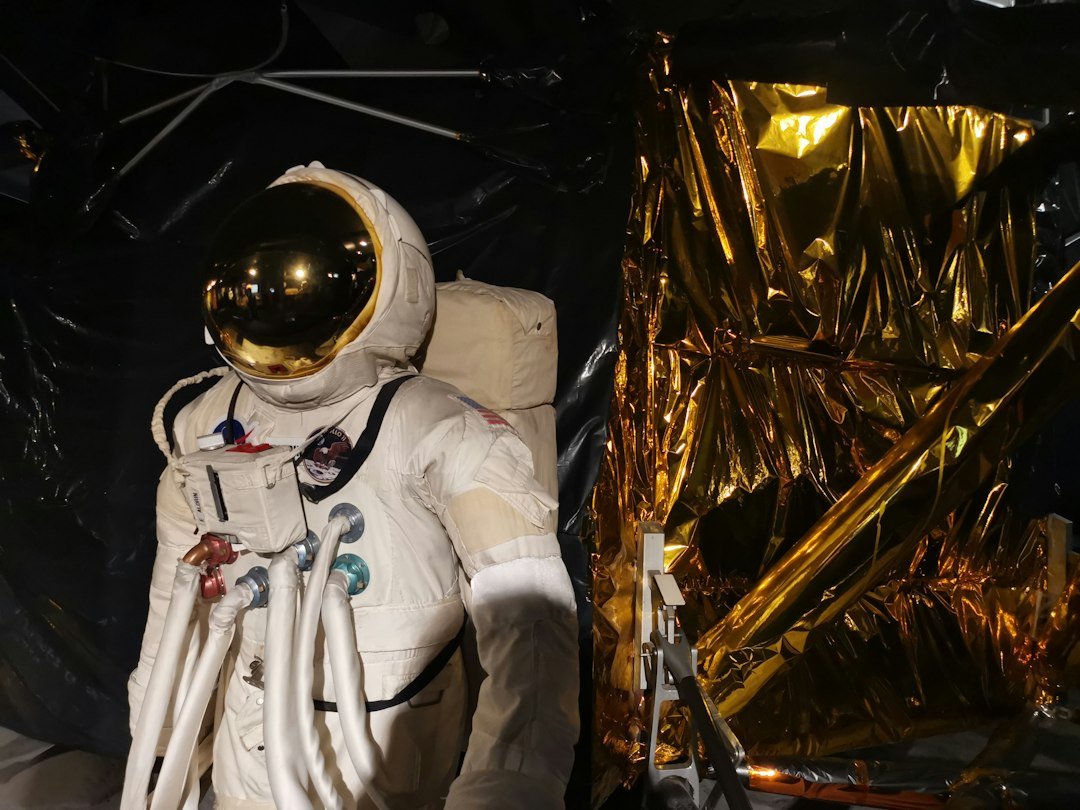
Featured image: stock photograph by Max Letek on Unsplash; shown as a visual metaphor, not a documentary image of the fictional setting.