Alien Ecosystem Worldbuilding: Build a Believable Food Web
Alien ecosystem worldbuilding starts before the first monster appears. Ask what energy supports life, where nutrients come from, which organisms consume or recycle them, and what limits growth. A believable alien planet does not need Earth animals with exotic colors. It needs an ecological system in which creatures affect one another and their environment.
Science-fiction writers can invent unusual biochemistry, but an ecosystem still needs a defensible story about energy flow and material cycling. This article gives you a usable framework and a complete invented example.
Step 1: choose the energy source
Life on Earth often draws energy from sunlight through photosynthesis, while other ecosystems rely on chemical energy. On an alien world, a writer might imagine organisms using illumination from a dim red star, chemical gradients near geothermal vents, or speculative metabolism with explicit constraints.
Do not start by choosing an apex predator. Start by asking who or what supplies usable energy to the base of the food web. NASA’s astrobiology learning material on energy and ecosystems distinguishes producers, consumers, and decomposers and emphasizes that matter cycles while energy flows.
Step 2: design the environmental limits
Climate, water availability, chemistry, gravity, atmospheric conditions, seasons, and light cycles shape organisms. An ocean beneath ice offers a different set of possibilities from a sunlit desert. A planet with long nights may reward stored energy and dormancy; a tidal shoreline may reward anchoring and rapid movement.
Pick three limits instead of describing every property of the planet. For example: low light, mineral-rich brine, and violent seasonal tides. Each limit should affect several species, not merely the creature the hero encounters.
Step 3: fill four ecological roles
| Role | Writing question | Invented example |
|---|---|---|
| Primary producer or energy harvester | How does usable energy enter the living network? | Brine mats that harvest dim sunlight |
| Primary consumer | Who eats the producers or uses their products? | Shell-backed grazers |
| Predator or parasite | How is energy transferred onward? | Ambush swimmers sensing vibrations |
| Decomposer or recycler | How do nutrients return to the environment? | Burrowing colonies breaking down remains |
Real ecosystems are networks, not neat four-step ladders. An organism can occupy several roles over its life. The categories help writers avoid a world filled with predators but nothing for them to eat.
Step 4: make adaptations answer real pressures
If the surface is frequently flooded, what grips the ground? If visibility is poor, what sensory cues matter? If nutrients are scarce, what grows slowly or cooperates with another organism? Let form and behavior respond to a problem.
For example, the grazers on our invented brine world may carry flexible anchoring filaments. Those filaments make them difficult prey in ordinary tides but dangerous to handle aboard a human exploration vehicle because they stick to the sample bay’s seals.
The Society of Science Fiction and Fantasy Writers’ article on ecology in worldbuilding highlights how interactions between organisms and environments add realistic story pressures. Our guide to building alien cultures from biology follows the consequences for intelligent species and societies.
Worked example: the brine archipelago
Imagine a fictional ocean world whose shallow islands emerge during a long tidal cycle. Blue-black mats gather light on exposed rock and store energy chemically. Small, shell-backed grazers scrape the mats and retreat beneath the brine when the tide rises. Larger ribbon swimmers sense the pressure waves of grazing herds and attack as the islands flood. Burrowing decomposers feed on carcasses that sink into soft sediment, returning nutrients to the mats through currents.
Now remove one organism: human explorers collect the grazers as a food source. Within a season, mats spread over navigation channels. Ribbon swimmers turn to new prey, including the explorers’ underwater maintenance drones. The resulting danger is not “because aliens are hostile.” It follows from disrupting a network.
Step 5: turn an ecological fact into a plot
- Mystery: One predator stops migrating. Is it extinct, ill, or responding to a hidden change in water chemistry?
- Conflict: Settlers want to remove a nuisance species, while researchers know it keeps a toxic mat under control.
- Character choice: A surveyor can save a stranded colleague by draining a lagoon, but that destroys the only known nursery for an intelligent aquatic species.
- First contact: The visitors mistake a nutrient exchange for religious ritual. The alien society regards the exchange as basic maintenance of its habitat.
The strongest ecology usually becomes visible through consequences. Readers needn’t memorize a taxonomy before they understand that one missing organism has changed the stakes.
An alien food-web worksheet for writers
- What is the primary source of usable energy?
- What are the three strongest environmental limits?
- What organism captures energy or builds living material?
- What eats that organism, and what eats the consumer?
- Who breaks down wastes and dead material?
- Which two species compete for the same limited resource?
- What seasonal event disrupts the network?
- What happens if a human expedition removes one species?
- What clue would a character notice before understanding the cause?
Frequently asked questions
Does an alien planet need plants and animals?
No. Those are Earth-centered categories. Your imaginary biology can differ, as long as readers understand how energy and materials circulate within the setting.
Can an ecosystem exist without sunlight?
Earth offers ecosystems supported by chemical energy. A fictional world can use that as a starting point, though its total energy budget and available chemistry still matter.
Should every species be scientifically explained?
No. Build a consistent private model and show the relationships essential to the scene. A few concrete interactions are usually stronger than a catalog of creatures.
To connect ecology with larger plots, read alien archaeology worldbuilding and first-contact worldbuilding. An alien biosphere becomes memorable when its living systems make characters reconsider what they thought was safe, valuable, or intelligent.
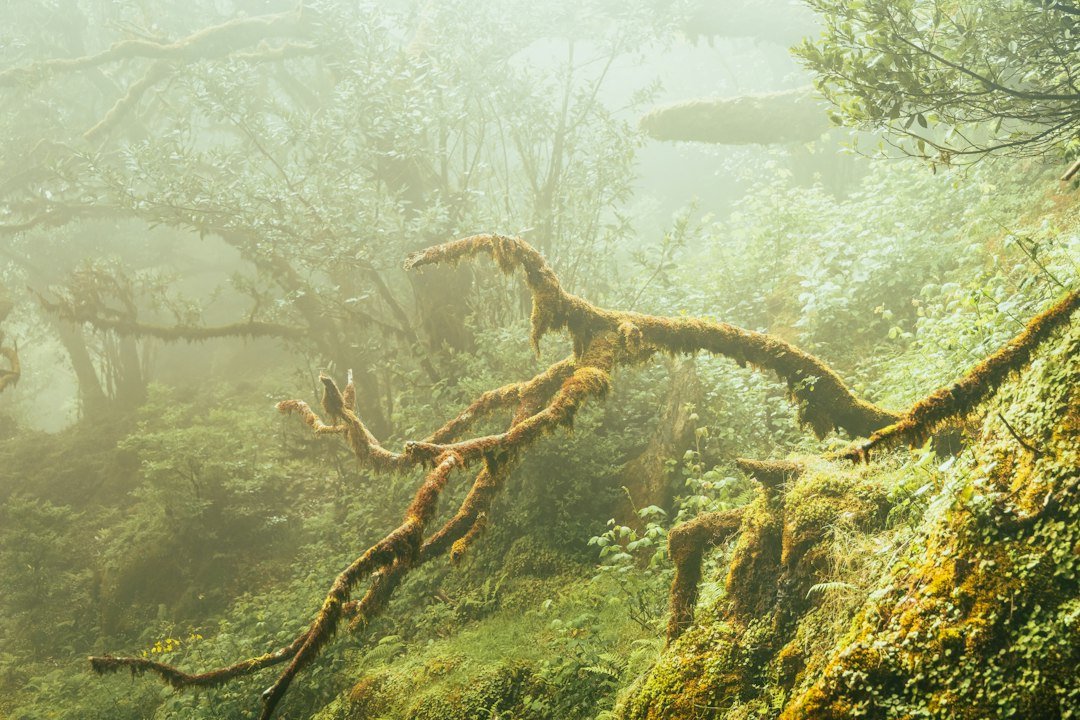
Featured image: stock photograph by Hans on Unsplash; shown as a visual metaphor, not a documentary image of the fictional setting.